Building Intentional Student Engagement
- Location
- UNC
- Size
- 10k + Polls run per semester
- Use case
- Education
The university took a strong stance and decided that Poll Everywhere needs to be an institution led, supported, and financed tool so that we can reduce the costs that students have to face for tuition, books, and technology.
From a faculty pilot to a university-wide system
Removing cost barriers and unlocking engagement across classrooms, offices, and conferences.
Bruce Richards, Senior Instructional Technologist at UNC Charlotte's Center for Teaching and Learning, had watched the university's previous student response system stagnate. Based on physical clicker hardware, it was expensive for students, limited in reach, and frustrating to use at scale. When the technology review cycle came around, it was time to find something better.
UNC Charlotte formed a faculty advisory group — including both current clicker users and instructors of large courses — and evaluated platforms against a structured rubric. Feedback from both the advisory group and the Student Government Association pointed decisively toward Poll Everywhere: easier to use, no hardware required, and compatible with the university's existing internet infrastructure.
Finding Poll Everywhere
The rollout began with a targeted pilot — 'faculty champions' in large courses were selected as first adopters and given hands-on training. Word of mouth spread quickly within the first year. The Center for Teaching and Learning then moved to intensive workshops, showing faculty not just how to use the tool, but how to integrate it pedagogically.
Once we rolled out the pilot, we were able to target those faculty members and more through word of mouth. We immediately went into intensive training and workshops to advise faculty, give them ideas on how Poll Everywhere could be integrated into their in-person and online courses.
How they use Poll Everywhere
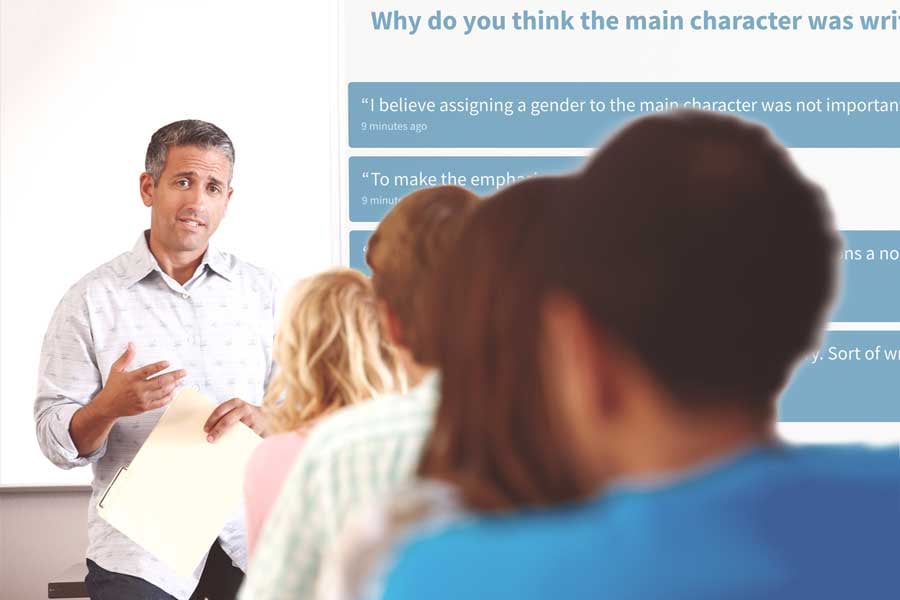
Faculty use a mix of graded and non-graded activities, with multiple choice and clickable image polls for assessments, and open-ended questions to deepen discussion. Competitions have recently gained traction, adding a gaming layer that, as Bruce notes, works best when faculty build them intentionally into the content rather than treating them as standalone entertainment.
Features they rely on
• Multiple-choice & Clickable Images — Used for graded activities; results export directly to Canvas
• Open-ended questions — Encouraged for deeper engagement — a student responding to an open question is thinking critically, not just attending
• Competitions — A gaming approach to content review; effective when tied directly to lecture material
• Canvas LTI integration — Enables direct grade export, reducing administrative friction for faculty
Engagement is much stronger than simply attendance. If faculty can get students to respond to an open-ended question, they're not only paying attention, but have a deeper understanding of the material and are thinking critically.
In the Classroom
Beyond classrooms, an unexpected benefit emerged: business and administrative departments across the university adopted Poll Everywhere for their own meetings, trainings, and conferences. Once the cost barrier was removed and the platform became institution-wide, adoption spread organically into contexts no one had planned for. In hybrid settings, Poll Everywhere became even more critical — offering instructors a way to gauge remote students' understanding as clearly as those in the room.
What the Research Shows
UNC Charlotte's model reflects research showing that when institutions remove cost barriers to participation tools, usage expands rapidly beyond the originally targeted audience. Studies consistently show that institution-funded engagement tools see higher adoption rates and broader use cases than individually purchased alternatives.
→ See the full research summary: polleverywhere.com/evidence-hub [link to Evidence Hub]
With the previous software, they all had to buy that physical device. Now that the barrier to entry was eliminated and the university made it an institution-wide system, they began to use Poll Everywhere for their own trainings, meetings, and even conferences outside of the physical university.